
Research
My research strengthens the resilience of public health systems by developing mechanistic and AI models that integrate infectious disease epidemiology with urban and built environment research. Findings have been translated into public health policies and engineering control measures.
Infectious disease transmission at the population level
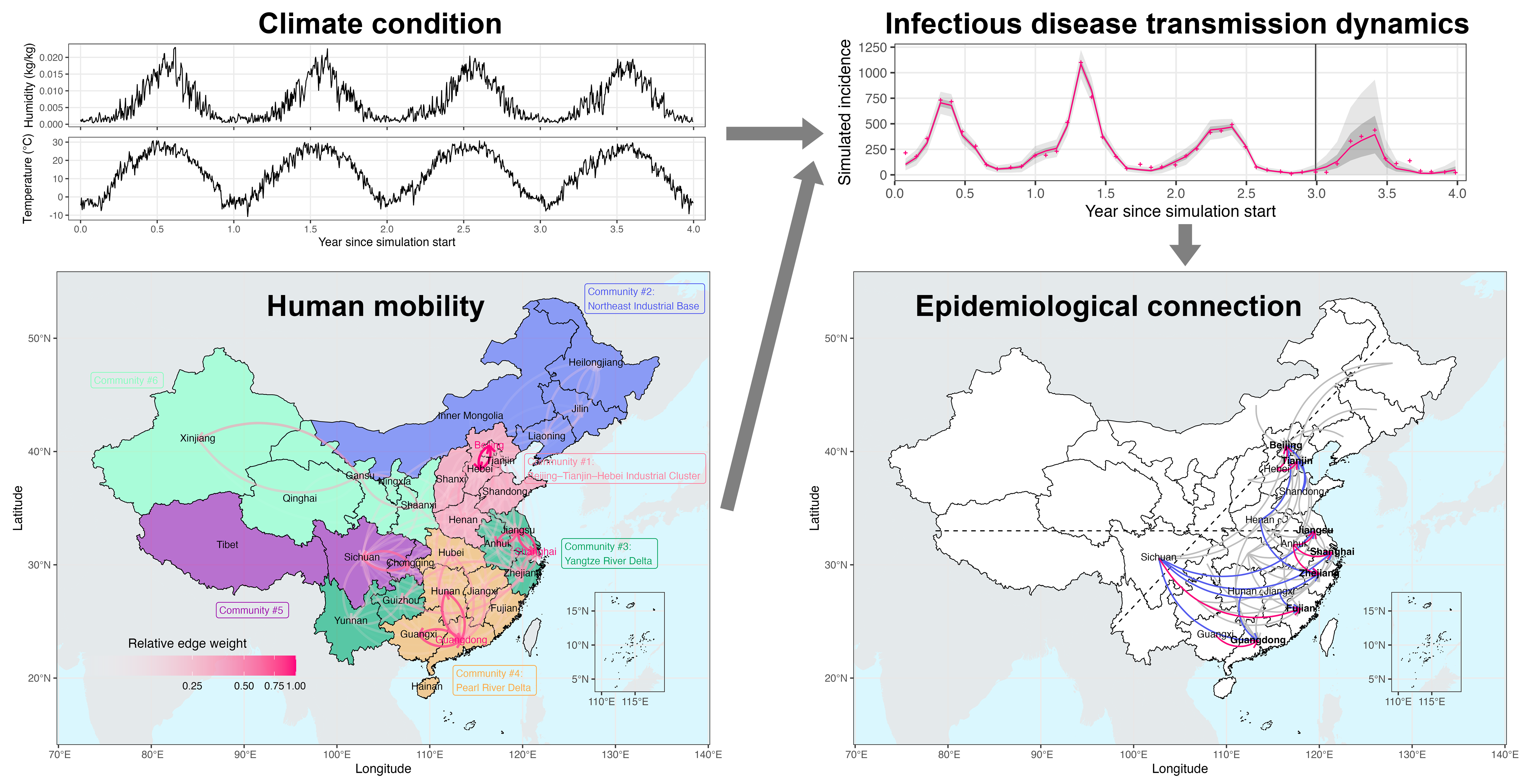
Despite routine childhood vaccination coverage exceeding the herd immunity threshold and substantial supplementary immunization activities toward the WHO Western Pacific Region’s measles elimination goal, measles epidemics have persisted in China. Epidemiological evidence suggests that worker migration and climate conditions may shape these epidemics. To test these hypotheses, I developed a climate-forced, networked metapopulation Susceptible–Exposed–Infectious–Recovered model that incorporated human mobility, demographic structure, and climate conditions, and used Bayesian iterated filtering for parameter inference (Wang et al. 2026, PLoS Comput Biol; Wang et al. 2025, Epidemiol Infect).
The model showed that measles epidemics were driven by the seasonal mobility of under-vaccinated rural-to-urban migrant workers around Chinese New Year and identified epidemiological connections between provinces. Counterfactual analysis showed that targeted vaccination of migrant workers with coverage ranging from 25% to 100% could reduce incidence by 31% to 50% nationwide. The model further identified a bimodal humidity effect, whereby both low and high absolute humidity levels increased measles transmissibility. By mechanistically modeling population and climate factors, I identified previously overlooked susceptible subpopulations as key epidemic drivers and showed how climate conditions modulate transmission. These findings can inform targeted vaccination strategies and support measles elimination efforts.
Microbial transmission at the building level
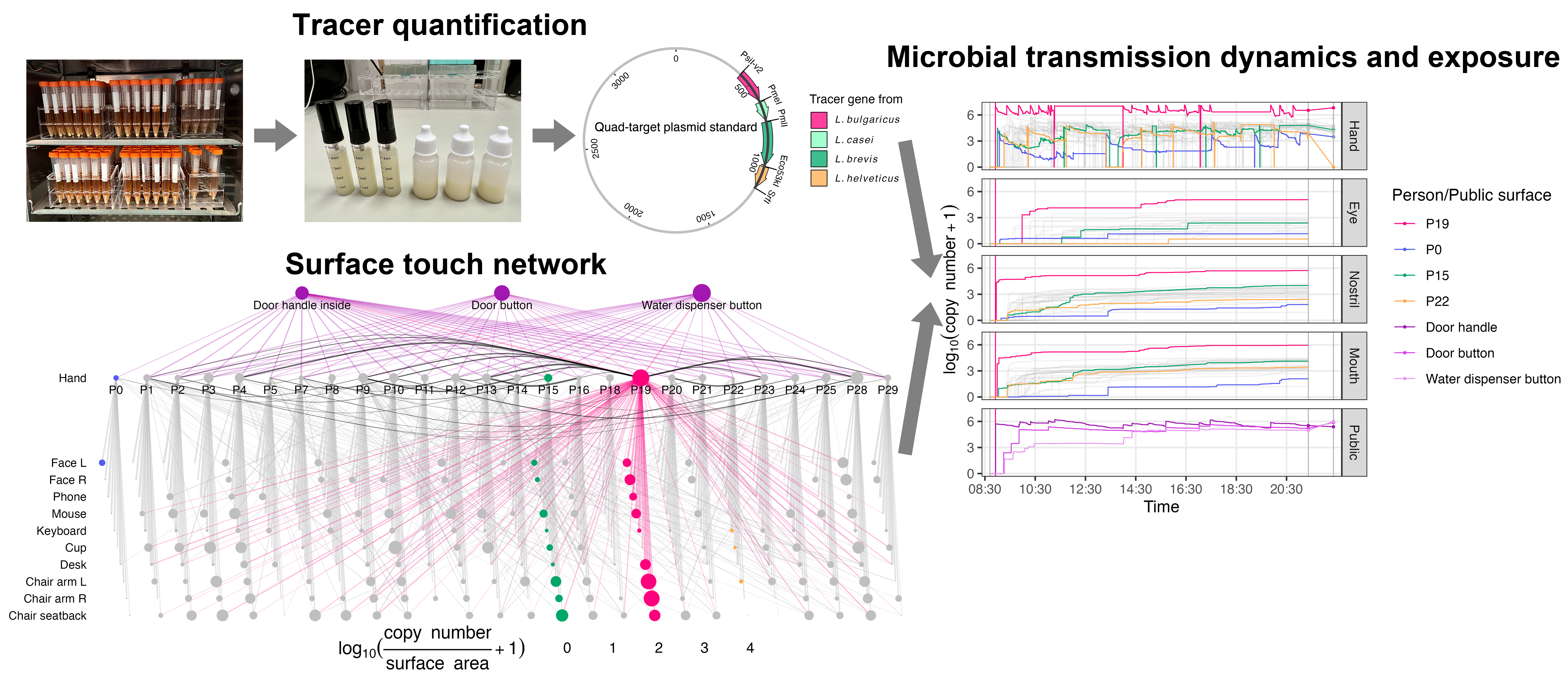
Fomite and airborne transmission are important infectious disease transmission routes, yet their human behavioral and environmental drivers, as well as realistic occupant exposure levels, remain unclear. To investigate fomite transmission, I developed surface touch networks and agent-based models to simulate transmission dynamics and occupant exposure in built environments (Zhao et al. 2025, Environ Sci Technol; Wang et al. 2021, J Hazard Mater). To provide molecular evidence for model calibration, non-toxic, non-human-origin surrogate tracers (Lactobacillus species) were introduced into built environments by carriers, and multiplex qPCR assays were developed to quantify their copy numbers on skin and surfaces (Wang et al. 2026, Under review; Wang et al. 2021, Build Environ). Calibrated using sequential neural posterior estimation against these qPCR measurements, the agent-based models showed that occupant exposure levels of the mouth, nostrils, and eyes to carrier introduced tracers were ~1–10 parts per million. Targeted hygiene of high eigenvector centrality public surfaces and timely handwashing upon entry to built environments could reduce exposure by one order of magnitude. These findings can support targeted hand and surface hygiene practices to control fomite transmission.
As a member of the Hong Kong special task force, I investigated SARS-CoV-2 airborne transmission by integrating building physics models with SF6 tracer gas experiments, showing that the chimney effect in soil stacks was a potential mechanism driving vertical transmission from lower to upper floors in high-rise residential buildings during winter. These findings have been translated into engineering measures to control vertical airborne transmission, including sealing water traps and maintaining drainage stacks.
Built environment microbiome
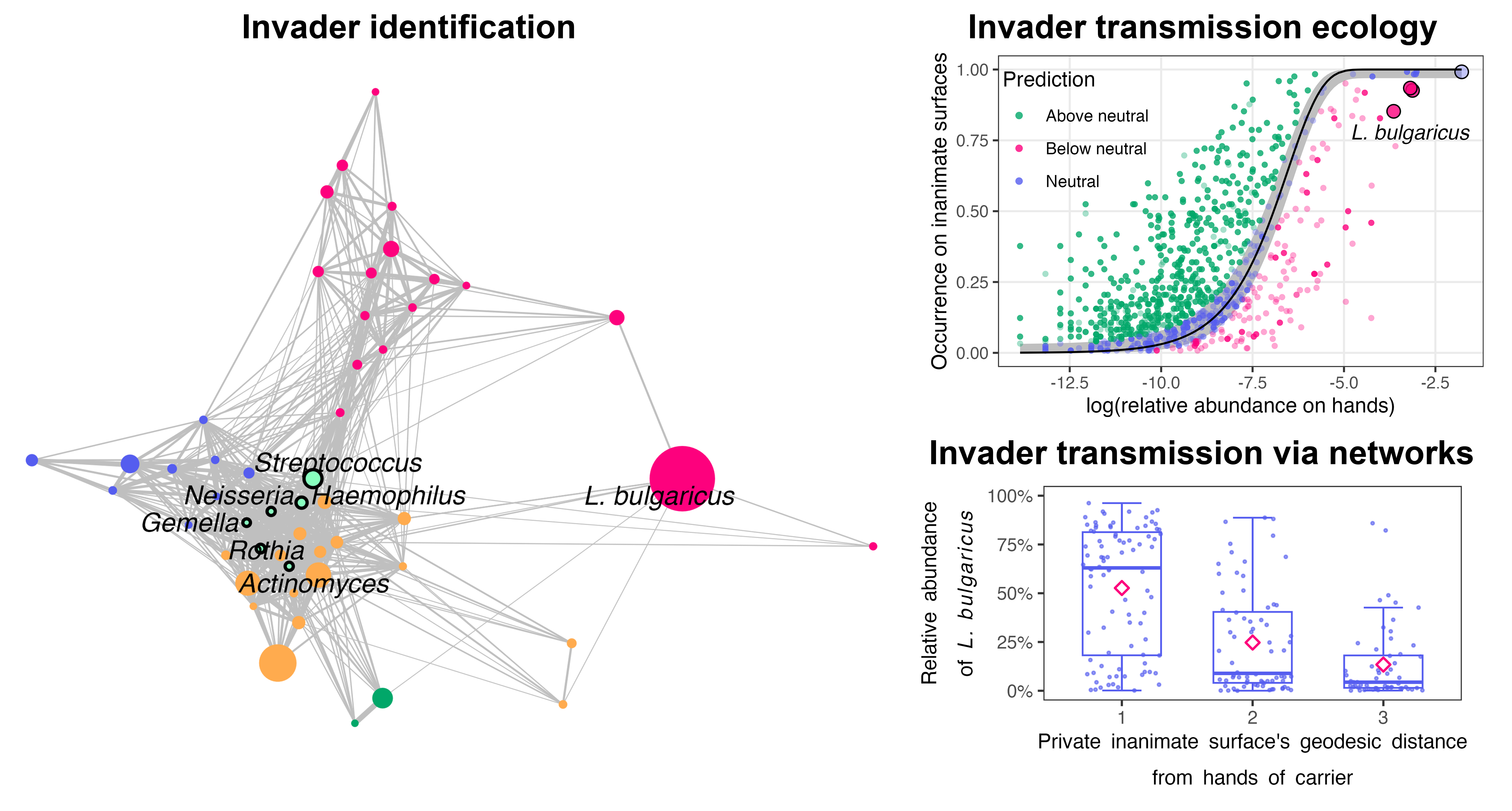
I further analyzed skin and surface samples to examine the invasion ecology of fomite transmission (Wang et al. 2022, mSystems). Microbiome interaction networks identified Lactobacillus as the invader, indicating that the invader was trackable. Neutral community models suggested a preferential association of the invader with skin over environmental surfaces. Additionally, surface touch networks showed an invader proximity effect, indicating that carrier behavior was the key driver of fomite transmission. These findings show the potential of applying invasion ecology theory to infectious disease research for pathogen tracing.