Hello!
I am a computational epidemiologist and environmental engineer specializing in infectious disease transmission across population, building, and microbiome levels. I am a Postdoctoral Fellow in the Department of Mechanical Engineering, The University of Hong Kong, working with Yuguo Li on AI for built environment research. Previously, I was a Postdoctoral Research Scientist in the Department of Epidemiology, Mailman School of Public Health, Columbia University, working with Wan Yang on infectious disease modeling. I received my Ph.D. from the Department of Mechanical Engineering, The University of Hong Kong, mentored by Yuguo Li, Patrick Lee, and Andrew Persily, with a focus on building environmental engineering, and my bachelor’s degree in Environmental Engineering from Zhejiang University.
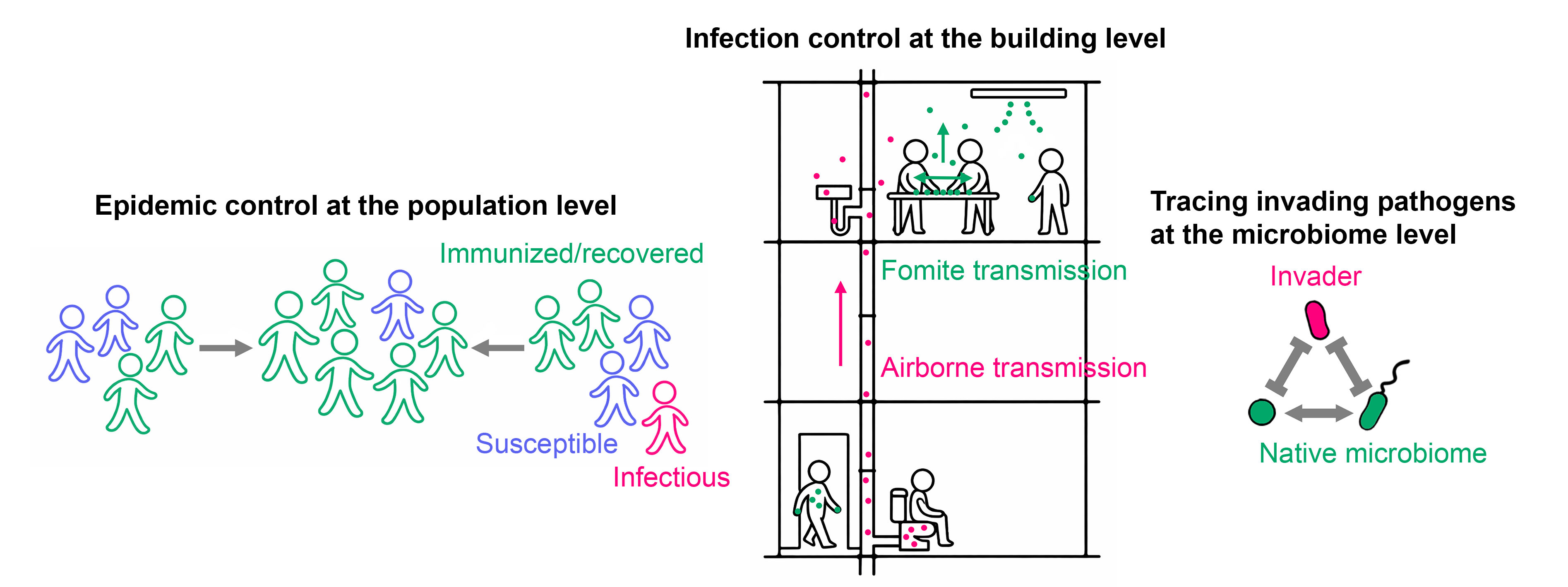
My research strengthens the resilience of public health systems by developing mechanistic and AI models that integrate infectious disease epidemiology with urban and built environment research to inform national epidemic control strategies and to support infection engineering control in buildings. Specifically, it comprises three complementary areas:
- Modeling measles transmission across metapopulations at the national level to quantify how migrant worker and traveler mobility, demographic structure, and climate conditions shape epidemics to optimize vaccination strategies and support elimination efforts;
- Modeling fomite and airborne transmission in buildings to quantify how occupant behavior and environmental conditions influence exposure risks and to support engineering control;
- Modeling microbial invasion ecology indoors to quantify invasion dynamics and support source tracking of microbial invaders.
My future research will integrate mechanistic modeling, AI, and multi-omics to advance public health systems that adapt to increasingly complex socio-technical networks, climate change, and emerging biological threats. I aim to advance two complementary areas:
- Developing an AI-augmented mechanistic modeling system for multi-scale, multi-lineage epidemic inference and emergency response;
- Developing a mechanistic microbiome modeling system for reducing healthcare-associated infections.
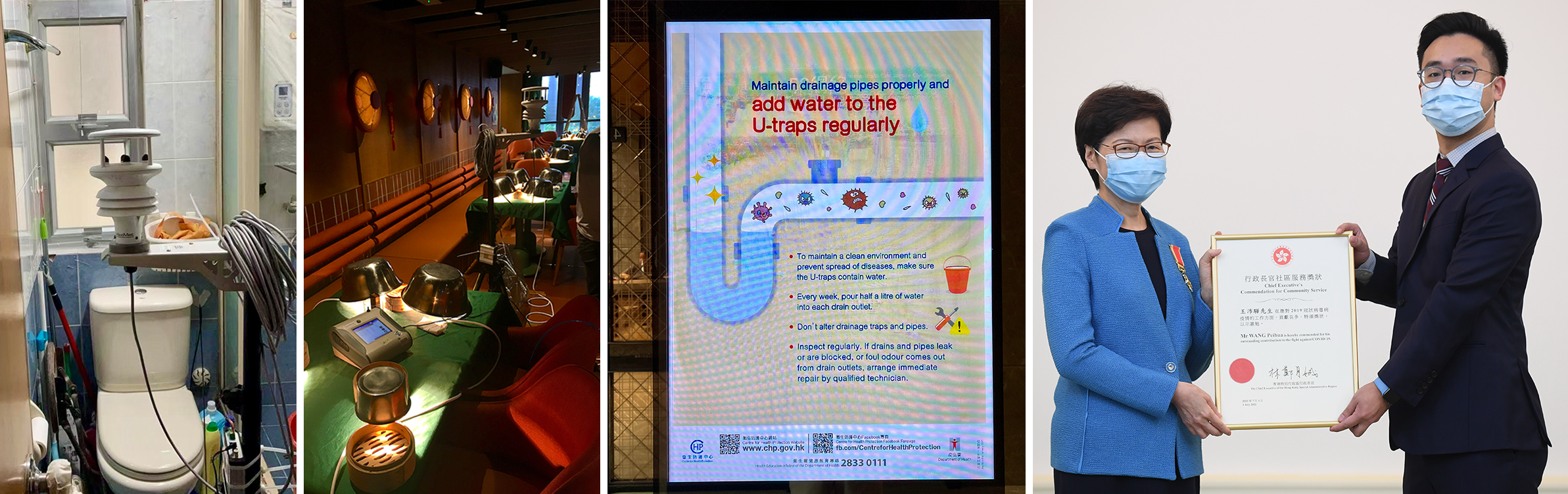
My approach is primarily computational, while also integrating experimental, fieldwork, and industry collaborative components. During my PhD, I established the first wet lab from scratch in a building physics lab, from procuring equipment to generating molecular evidence that validated modeling results. Additionally, I have extensive experience in infectious disease fieldwork in residential and commercial buildings, aircraft cabin environments, subway systems, clinical settings, and poultry markets. During the COVID-19 pandemic, I served on the Hong Kong special task force, and my fieldwork on SARS-CoV-2 airborne transmission via the chimney effect in building drainage systems and on-site outbreak control were recognized by the Hong Kong Chief Executive’s Commendation for Community Service. I also obtained research funding from Procter & Gamble Singapore Innovation Center in a PI-equivalent role for a household hygiene innovation project.